
 it
it en
en fr
frCLINICAL STUDIES AND REFERENCES on TOUL – Focused Laminar Airflow
The scientific literature on TOUL is extensive, multidisciplinary, and continuously growing.
All studies were conducted independently by the respective clinical centers.
Only a selection of the available publications is presented here.
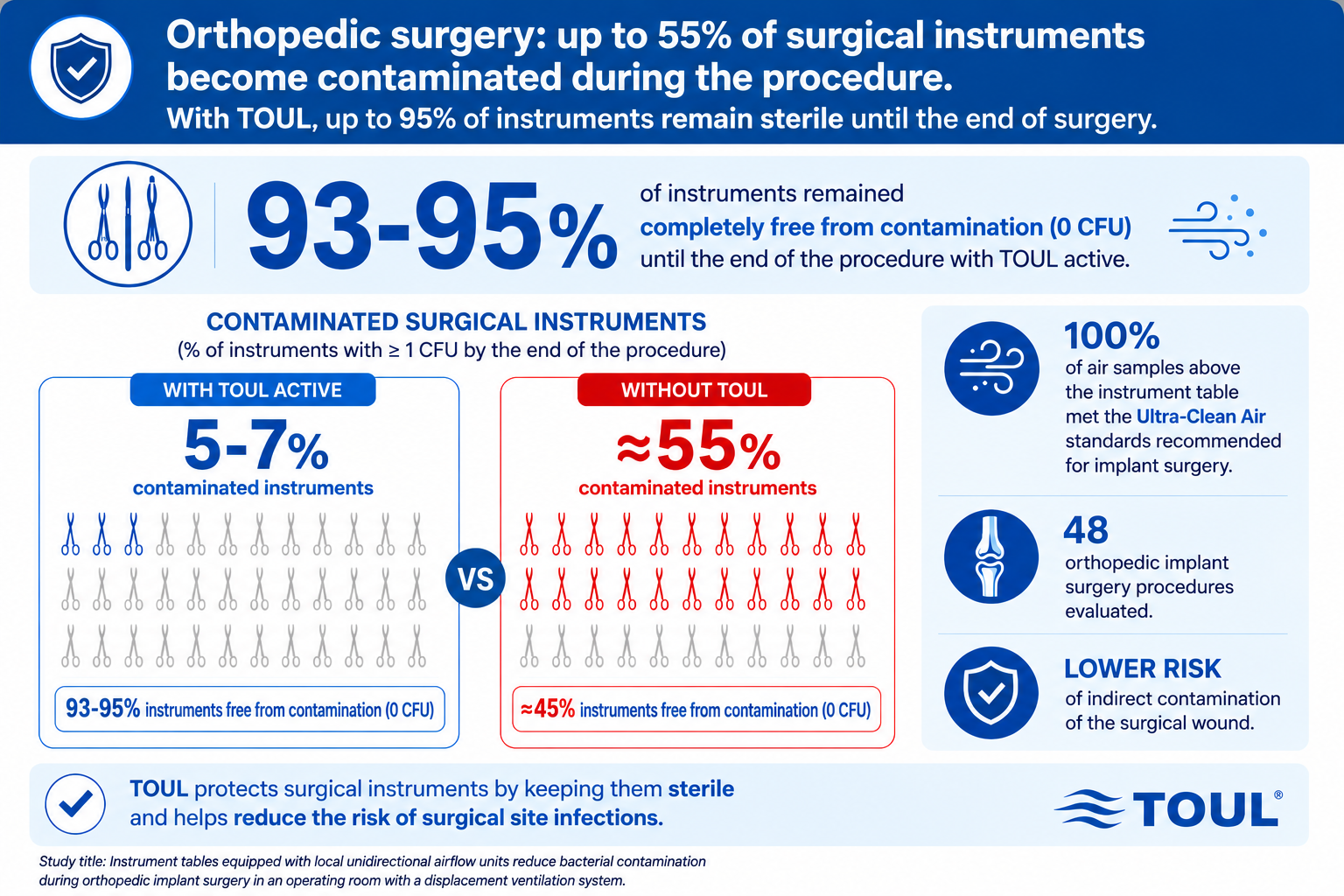
Orthopedic surgery: up to 55% of surgical instruments become contaminated during the procedure. With TOUL, up to 95% of instruments remain sterile until the end of surgery.
A clinical study conducted during 48 orthopedic implant surgery procedures evaluated the effectiveness of TOUL in protecting surgical instruments from intraoperative bacterial contamination. The results showed that, with TOUL in operation, 93–95% of the instruments remained completely free from contamination (0 CFU) until the end of surgery. In contrast, without TOUL, up to approximately 55% of the instruments were contaminated. In addition, 100% of the air samples collected above the instrument table met the ultra-clean air standards recommended for implant surgery.
Study title: Instrument tables equipped with local unidirectional airflow units reduce bacterial contamination during orthopedic implant surgery in an operating room with a displacement ventilation system.
Why it matters
Surgical instruments can represent a source of surgical site contamination. Keeping them sterile until the end of surgery helps reduce the risk of indirect contamination of the surgical wound.
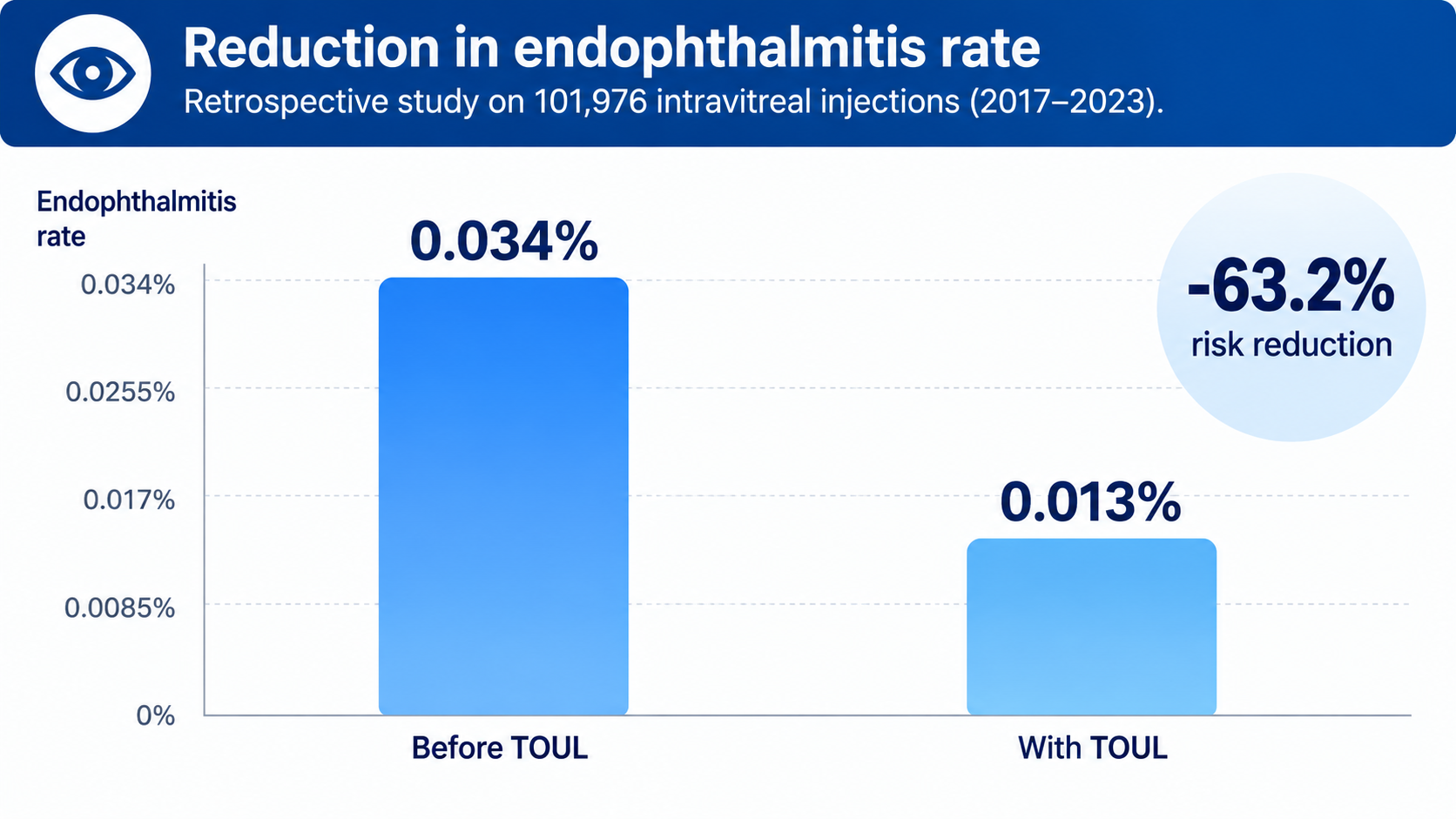
More than 100,000 procedures show that TOUL reduces the risk of infection by 63%.
A retrospective clinical study analyzed 101,976 intravitreal injections performed between 2017 and 2023, comparing the incidence of endophthalmitis before and after the introduction of TOUL Operio Mobile. The results showed a reduction in the infection rate from 0.033% to 0.013%, corresponding to a 63.2% reduction in risk (OR = 0.368; p = 0.04). The study confirms that the use of TOUL helps improve protection of the treatment field and provides valuable support in enhancing the safety of intravitreal injections.
Study title: Impact of a laminar air flow portable device on post-intravitreal injection endophthalmitis rate.
Why it matters
Endophthalmitis is a rare but potentially devastating complication. Significantly reducing its incidence means providing patients with an even safer treatment.
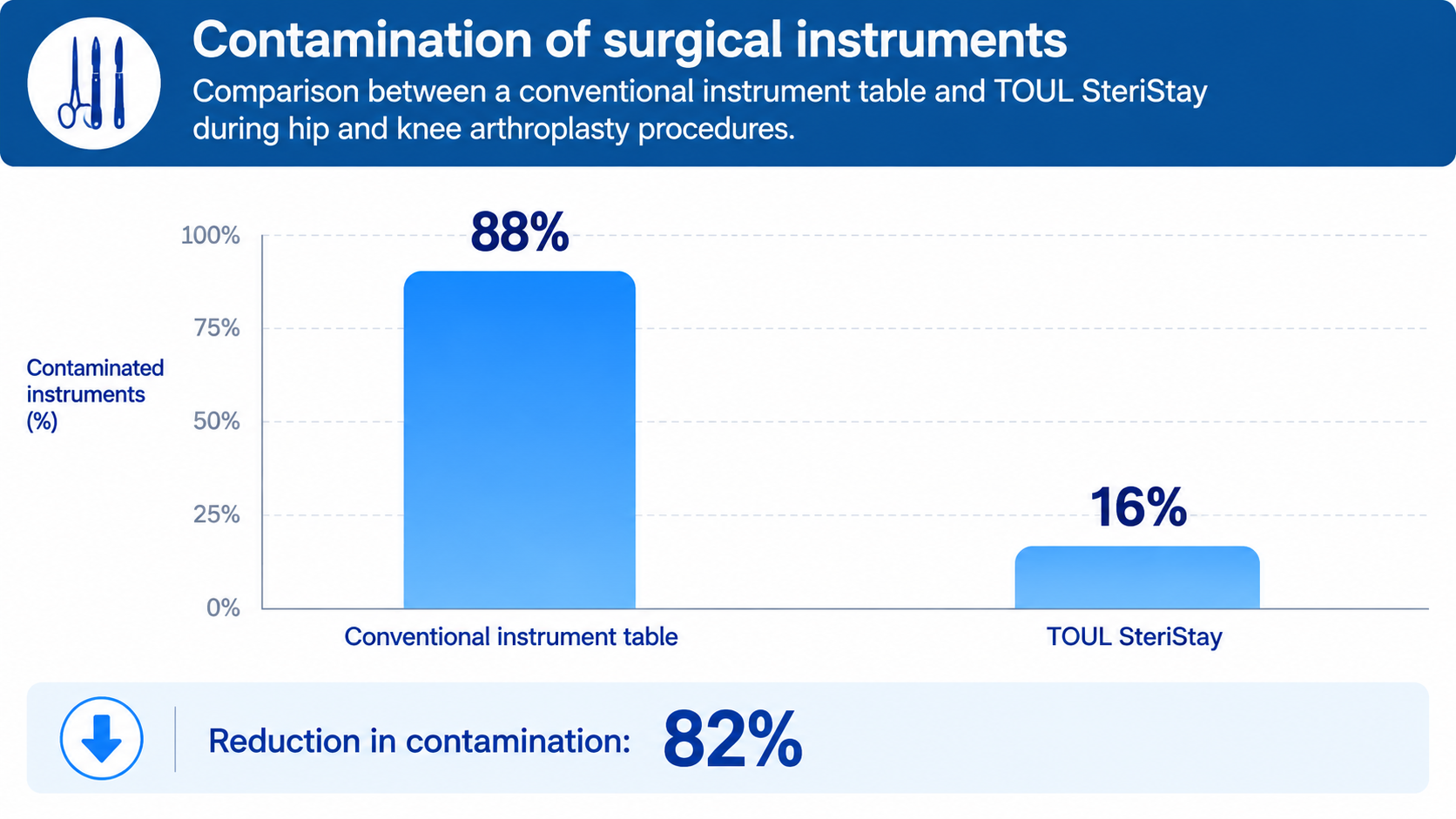
TOUL reduces surgical instrument contamination by 82%.
A prospective controlled study compared the microbiological contamination of surgical instruments placed on a conventional instrument table and on TOUL SteriStay during hip and knee replacement procedures. The results showed that only 16% of the instruments placed on SteriStay were contaminated, compared with 88% on the conventional table, corresponding to an 82% reduction in contamination. In addition, the bacterial concentration measured above the SteriStay table met the requirements of DIN 1946-4 Class Ia (equivalent to ISO 5). The study confirms that TOUL SteriStay helps protect surgical instruments from contamination throughout the entire procedure.
Study title: Possible contamination of instruments in the operating theatre during implantation of hip and knee endoprostheses.
Why it matters
Even in modern operating rooms, instruments can become contaminated during surgery. Protecting them until the moment of use helps reduce the risk of surgical site contamination.
TOUL achieves Class Ib operating room standards (ISO 5) even in Class II environments (ISO 7).
A clinical study conducted during 26 surgical procedures evaluated the effectiveness of TOUL Operio in creating a sterile area within a Class II operating room without a dedicated ventilation system. The results showed a reduction in bacterial contamination of up to 91.5% on the instrument table and 65.2% near the surgical site, together with a 66% reduction in airborne particles. The microbiological and particle levels achieved within the protected area were comparable to those required for a Class Ib operating room, confirming that TOUL can create highly aseptic conditions without structural modifications to the ventilation system.
Study title: Achieving room air quality of room class Ib in the aseptic area using a mobile sterile ventilation unit in a room class II surgical unit.
Why it matters
TOUL makes it possible to create a localized sterile area with standards comparable to a Class Ib operating room (ISO 5), expanding the possibility of safely performing surgical procedures even in environments without dedicated ventilation.
TOUL reduces bacterial contamination at the surgical site by 85% during knee replacement surgery.
A prospective clinical study conducted during 34 total knee arthroplasty procedures evaluated the effectiveness of TOUL Operio as an adjunct to conventional operating room ventilation. The results showed an 85% reduction in airborne bacterial contamination near the surgical wound, decreasing from 23.5 to 3.5 CFU/m³. A significant reduction in airborne particles was also observed, with levels consistent with ultra-clean operating room standards. The study concludes that TOUL can achieve levels of asepsis comparable to those of an operating room with dedicated laminar airflow ventilation, helping to reduce the risk of surgical site infections without the need for costly structural modifications.
TITLE: Mobile laminar air flow screen for additional operating room ventilation: reduction of intraoperative bacterial contamination during total knee arthroplasty.
Why it matters
Reducing bacterial contamination around the surgical wound is one of the key factors in limiting the risk of surgical site infections in implant surgery.
More than 10,000 intravitreal injections confirm the safety of TOUL: no cases of endophthalmitis.
A retrospective clinical study evaluated the safety of 10,016 intravitreal injections performed between April 2023 and November 2024 using TOUL Operio Mobile. During the observation period, no cases of endophthalmitis or rhegmatogenous retinal detachment were reported, confirming the high safety profile of the procedure. The study concludes that TOUL provides an effective solution for supporting the performance of intravitreal injections in a dedicated setting, improving clinical workflow and allowing the operating room to be reserved for more complex procedures.
Study title: Safety of intravitreal injections with the mobile laminar airflow device Operio after more than 10,000 injections.
Why it matters
The absence of endophthalmitis in more than 10,000 consecutive procedures confirms that high safety standards can also be maintained in a dedicated setting for intravitreal injections.
More than 6,600 intravitreal injections confirm the safety of TOUL in an outpatient setting.
A retrospective clinical study analyzed 6,638 intravitreal injections performed between 2021 and 2024 using TOUL Operio Mobile in a dedicated setting outside the operating room. During the observation period, only one case of endophthalmitis was reported, corresponding to an incidence of 0.015%, among the lowest rates reported in the literature. The authors conclude that TOUL provides a safe and effective solution for performing intravitreal injections, helping to optimize the use of operating rooms without compromising patient safety.
Study title: Safety outcomes of a mobile laminar airflow device to perform intravitreal injections: a 3-year retrospective study.
Why it matters
The high level of safety demonstrated across more than 6,600 procedures confirms that TOUL enables intravitreal injections to be performed in a dedicated setting while maintaining an extremely low risk of infection.
TOUL increases productivity and reduces the cost of intravitreal injections by 26% (€120).
An Italian multicenter study evaluated the use of TOUL Operio Mobile to perform 3,838 intravitreal injections in a dedicated setting outside the operating room. The results showed a 14% increase in productivity, with a 26% reduction in cost per procedure, while maintaining high standards of clinical safety. The authors conclude that TOUL improves workflow organization, optimizes operating room utilization, and makes the patient care pathway more efficient.
Study title: Intravitreal Injections during the COVID-19 Outbreak in Northern Italy: An Innovative Approach for a High Quality and Safe Treatment.
Why it matters
TOUL makes it possible to increase operational capacity, reduce costs, and free up the operating room for more complex procedures, while maintaining high standards of patient safety.
TOUL purifies the air over the surgical field, reducing airborne particles by up to 91%.
A prospective study conducted during 116 cataract procedures evaluated the effectiveness of TOUL Operio Mobile in reducing airborne contamination within the sterile field. The results showed that no textile fibers (lint) fell directly onto the surgical field when TOUL was used. In addition, TOUL reduced 5.0 μm particles by 91%, 1.0 μm particles by 82%, and 0.5 μm particles by 79%, helping to maintain a cleaner and more protected surgical environment.
Study title: Purifying air over the operating field with a new mobile laminar airflow device to reduce the possibility of airborne contamination.
Why it matters
Airborne particles and textile fibers can represent a source of contamination of the surgical field. Drastically reducing their presence helps improve aseptic conditions during surgery.
TOUL ensures ultra-clean air levels during neurosurgical procedures.
A clinical study conducted at Karolinska University Hospital evaluated the effectiveness of TOUL Operio and SteriStay during 45 neurosurgical procedures over an 18-month period. The results showed a significant reduction in airborne bacterial contamination both near the surgical site and above the instrument table (p < 0.001), achieving ultra-clean air levels (<10 CFU/m³). Statistical analysis also showed that the use of TOUL was the only factor significantly associated with reduced bacterial contamination, regardless of the number of people present in the operating room or door openings.
Study title: Effect of mobile laminar airflow units on airborne bacterial contamination during neurosurgical procedures.
Why it matters
Neurosurgery requires the highest standards of asepsis. Maintaining ultra-clean air levels at the surgical site and over the instruments helps reduce the risk of contamination during highly complex procedures.
TOUL maintains the same microbiological standards as the operating room in an outpatient setting.
A case-control study compared microbiological air contamination during sessions of 30 intravitreal injections performed in a dedicated outpatient setting using TOUL Operio Mobile and in a hospital operating room. After activation of the system, bacterial contamination at the treatment site decreased from 20.33 to 1.00 CFU/m³ and remained at 4.33 CFU/m³at the end of the session. Throughout the procedures, the microbiological levels measured were comparable to those in the operating room, demonstrating that TOUL can maintain a microbiologically controlled environment even in a dedicated outpatient setting.
Study title: Mobile unidirectional airflow device reduces air contamination in an intravitreal outpatient clean room setting.
Why it matters
TOUL enables intravitreal injections to be performed in a dedicated outpatient setting while maintaining the same microbiological standards as the operating room, without the need for structural modifications.
TOUL brings cataract surgery into the outpatient setting: zero postoperative infections in 1,269 procedures.
A prospective study evaluated 1,269 cataract procedures performed in three dedicated outpatient facilities using TOUL Operio Mobile to create a sterile field. No cases of postoperative infection were reported during the entire observation period (0/1,269). The pathway also resulted in high patient satisfaction and an average stay of only 74 minutes for unilateral procedures. The authors conclude that TOUL enables cataract surgery to be performed in an outpatient setting while maintaining high standards of safety, quality, and organizational efficiency.
Study title: Initial experiences of cataract & lens surgery in 1269 patients in outpatient clean rooms using a portable laminar air flow device.
Why it matters
This study demonstrates that TOUL enables cataract surgery to be performed in a dedicated outpatient setting while maintaining high safety standards and helping to optimize operating room utilization.
TOUL creates a protected zone, reducing airborne contamination by up to 99.999%.
An experimental study evaluated the effectiveness of TOUL Operio Mobile in creating a protected area during a simulated intravitreal injection in an environment without mechanical ventilation. The results showed a reduction in airborne contamination of up to 99.999% on the instrument table and up to 99.77% at the treatment site, compared with the surrounding environment. The study confirms that TOUL can generate a highly protective unidirectional airflow, helping to maintain sterility in the most critical areas of the procedure and providing the scientific basis for subsequent clinical studies.
Study title: Mobile ultra-clean unidirectional airflow screen reduces air contamination in a simulated setting for intra-vitreal injection.
Why it matters
This study demonstrates the effectiveness of TOUL’s localized laminar airflow in protecting the instrument table and treatment site from airborne contamination, even in environments without dedicated ventilation.
TOUL extends the sterile area, reducing airborne particles over the instrument table by 97%.
An experimental and clinical study evaluated the effectiveness of an instrument table equipped with TOUL laminar airflow as an extension of an operating room with ultra-clean ventilation. The results showed that the system does not interfere with the main laminar airflow and reduces airborne particles >5 μm above the instrument table by 97%(275 vs 8,550 particles/m³), confirming the system’s ability to maintain surgical instruments in a significantly more protected environment.
Study title: The addition of a mobile ultra-clean exponential laminar airflow screen to conventional operating room ventilation reduces bacterial contamination to operating box levels.
Why it matters
Extending the sterile area makes it possible to protect a larger number of surgical instruments without compromising the performance of the operating room ventilation system, improving aseptic conditions during more complex procedures.
High-risk surgery: TOUL reduces bacterial contamination by 89% on the instrument table and by 60% at the surgical site.
A prospective clinical study evaluated the effectiveness of TOUL Operio Mobile during 76 urological laparotomies, comparing 42 procedures performed with conventional ventilation and 34 with the support of mobile laminar airflow. The results showed a reduction in bacterial contamination on the instrument table from 2,730 to 305 CFU/m²/h (−89%) and near the surgical site from 4,031 to 1,608 CFU/m²/h (−60%). A significant reduction in airborne particles in the surgical area was also observed, without affecting the microbiological air quality in the rest of the operating room. The study confirms that TOUL effectively protects the most critical areas during surgery, even in conventionally ventilated operating rooms.
Study title: A mobile laminar airflow unit to reduce air bacterial contamination at surgical area in a conventionally ventilated operating theatre.
Why it matters
This study demonstrates that TOUL simultaneously protects the instrument table and the surgical site from bacterial contamination, improving aseptic conditions during high-risk procedures without requiring modifications to the existing ventilation system.
Orthopedic surgery: with TOUL, microbiological contamination of the instrument table is reduced by up to 97%.
A technical validation report conducted at St. Marien Hospital in Hamm compared the microbiological contamination of surgical instruments placed on TOUL SteriStay with those placed on a conventional instrument table during knee and hip replacement procedures. The results showed a 97.5% reduction in bacterial contamination on settle plates (from 3.14 to 0.13 CFU/h) and a 97.4% reduction on surgical instruments (from 6.27 to 0.16 CFU/h). In addition, only 10%of the plates exposed on TOUL were contaminated, compared with 98% on the conventional table. The values achieved with TOUL met the microbiological requirements of DIN 1946-4 Class Ia, corresponding to the contamination levels required for ultra-clean environments.
Technical validation report title: Ergebnisse der „toul“-Studie in Zusammenarbeit mit der St. Marien Hospital Hamm.
Why it matters
An instrument table with extremely low levels of microbiological contamination provides important support for maintaining intraoperative asepsis, helping to preserve the microbiological quality of surgical instruments throughout the procedure, particularly during long procedures and surgeries with a high risk of infection.
TOUL improves the organization of intravitreal injections, reducing costs and waiting times.
This article examines new organizational models for performing intravitreal injections, highlighting how the use of TOUL Operio Mobile in a dedicated clean room makes it possible to move procedures outside the operating room while maintaining high safety standards. The experience at Treviso Hospital demonstrated lower costs, shorter waiting times, and more efficient use of operating rooms, without an increase in infectious complications. The authors emphasize that this organizational model provides a practical response to the growing number of patients requiring intravitreal treatments.
Article title: Intravitreal Injections: New Organizational Scenarios.
Why it matters
The article shows that TOUL not only improves procedural safety but also makes it possible to rethink the organization of intravitreal injections, increasing care capacity and making the patient pathway more efficient and sustainable.